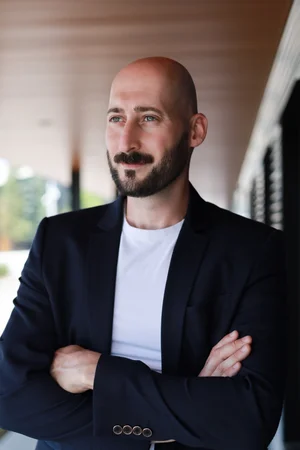
The Road My Father Walked
There is something about returning to Chouaya that is difficult to explain.
It was my father’s village before it was ever mine. The place where his family came from, where he knew the roads, the land, the people and the way of life long before he left Lebanon and built another life in Canada.
And somehow, through him, it became part of me too.
This trip felt different.
I came back to South Lebanon carrying the weight of my father, my own memories, and the strange realization that so much time had passed since one particular journey we made together.
Twenty five years ago, when I was sixteen, my father and I walked from Chouaya to Khalwat Al Bayada.
A couple of years earlier, doctors had discovered a lump on the left side of my throat. It was removed surgically and thankfully the biopsy came back benign. What I did not know at the time was that my father had made a promise to God.
If he ever returned to Lebanon, he would walk the rocky path to Bayada barefoot and ask for protection over me. If he failed to keep that promise, he asked that whatever sickness had been intended for me be given to him instead.
He kept that promise.
At sixteen, I understood what he had done as an act of love. Today, as a father myself, I understand it differently.
I understand the helplessness that comes with loving your children. The instinct to protect them from things you know you cannot always control. I understand why a father might make a promise that reaches beyond logic.
So I made the walk again. The road is paved now. New homes have been built along it. You still descend from Chouaya before beginning the climb toward Bayada, with the mountains of South Lebanon stretching around you.
The scenery is breathtaking, but what stayed with me was everything beneath it. For me, the walk was a choice. For my father, it was a promise.
For generations before us, it was simply how people moved through these mountains. On foot, by horse, by donkey. My ancestors would have crossed these same hills long before any of us existed.
That thought stayed with me throughout the walk.
When I was sixteen, my father stood between me and those generations. Today, he belongs to them.
Fifteen years have passed since he died, yet I continue to understand him in new ways. I understand his worries differently now. His responsibilities. The weight he must have carried as a father, a husband, a business owner and an immigrant building a life far from the village where his own story began.
There are things I wish I could tell him today. Things I understand now that I did not understand when he was alive. That is one of the strange things about grief. The person is gone, but you continue changing. You reach new stages of your own life and suddenly something they once said makes sense in a way it never did before.
Walking from Chouaya to Bayada felt like some version of that conversation. I wanted my feet on the same ground. I wanted to look across the same mountains.
I wanted to walk the route we had once walked together and feel, even for a moment, that the distance between then and now was a little smaller.
I went to Bayada to pray too. For myself. For my family. For people in my life. My relationship with faith has never been simple, but perhaps it does not need to be. My father once walked that road carrying a prayer for me. Twenty five years later, I walked it carrying prayers of my own.
And then there is Chouaya itself. The village means something different to me now than it did when I was younger. When you are a child, your father’s village is simply somewhere your family is from. A name. A place on a map. A collection of relatives, stories and old photographs.
Then you get older. The people who once explained the village to you begin to disappear. The stories become yours to carry.
And slowly, the place stops feeling like somewhere your father came from and begins feeling like somewhere you come from too. That was perhaps the strongest feeling of this trip. Coming home.
Not in a sentimental way. Lebanon is too complicated for that. South Lebanon continues to live with war, attacks and tremendous hardship. There is pain there that cannot be romanticized. Yet life continues. Families remain. People build homes, tend the land, harvest olives, grow fruit, raise children and somehow continue moving forward.
Chouaya carries that same contradiction. There is hardship, but also extraordinary generosity. People who may have very little who still want to give you everything. People who make you understand that community is not something you speak about. It is something you do.
My father came from that place. And being there helped me understand something about him too.
Maybe some of what I always thought was simply his personality was also Chouaya. The generosity. The loyalty. The stubbornness. The need to provide. The attachment to family. The way home never really stopped being home, even after decades away.
This trip brought those pieces together for me. Chouaya. Bayada. Lebanon. My father. My own family. The people who came before us and the people who will come after.
I started that walk thinking about my father. came back thinking about where I came from.
Twenty five years ago, I walked from Chouaya to Bayada beside him. This time, I walked without him.
But somehow I felt closer to him, closer to the village, and closer to a part of myself that I think I am only now beginning to understand.
Coming home can mean many things. This time, it meant all of them.